THE CITIZEN BLOG
THE CITIZEN BLOG

Turning Good Intentions Into Action
As CEO of Hands On Atlanta, I spend my days thinking about the future of volunteering and community service. A few months ago I had chance to share some of those thoughts with a group of enthusiastic business undergrads, as part of Georgia Tech’s Impact Series.
My talk was centered around a core belief -- that the most overlooked and underutilized resource in the world today, is that of people's good intentions. I see several trends which have the potential to completely disrupt the volunteering landscape, and in doing so, turn those good intentions into meaningful action:
Nonprofits no longer hold a monopoly on doing good: Over the next 5-10 years, there will continue to be a convergence of for-profit and nonprofit organizations. It is already difficult to tell them apart, and this trend will continue as legal structure loses its status as a competitive differentiator. Nonprofits are going to find themselves competing directly with for-profit organizations for the social license to "do good". Image the good that will be unlocked when companies start using their billion-dollar marketing budgets to directly engage people in their sustainability or corporate social responsibility efforts.
- Volunteering goes virtual: When you imagine someone volunteering…do you picture them in front of a laptop or doing it on their mobile phone while in line at Starbucks? There are currently an endless number of ways to give money today using a tweet or SMS. And there are an infinite number of ways for someone to do good if they are willing to invest a few hours or a few days. But in the middle, there is a huge, green space…a blue ocean for innovators and entrepreneurs to dive into. I believe innovations in this space will be made possible by technology. Much like Amazon is disrupting big-box retailers, online volunteer platforms will disrupt big-box nonprofits. Over the next 10 years, I predict that the number of hours volunteered online will surpass traditional volunteering. This will further reduce the friction associated with volunteering today, and allow it to become more integrated into our daily lives.
- Investing is the new philanthropy: People are revisiting the relationship they want their capital to have with the world. They are seeking a role for capital to play beyond just maximizing profits, and thinking about the social and environmental issues that can be addressed through investment. And it isn’t just wealthy individuals. It is also ordinary citizens who are asking their 401K and pension fund managers to respond to local and global issues. There is roughly $375 Billion donated to charity in the US every year. But we are dealing with Trillion-dollar problems. Basic math shows us that we must find a way to unlock new sources of capital if we are truly going to move the needle on poverty, homelessness and hunger. The World Economic Forum has predicted that the impact investing market will grow to $500 Billion over the next 5 years. As new models emerge, we are going to see a tremendous increase in the amount of money that is being invested in "doing good".
- What it means to "volunteer" is evolving: Volunteering itself is evolving to keep pace with changing business models. New engagement models will come from collaborative consumption, the sharing economy, crowdfunding, virtual reality and other innovations. And in doing so, we will need to change our language and the definition of volunteering to keep pace. The word “volunteer” will either need to evolve, or it will be supplanted by terms like “activist” and “change maker”.
I believe we will see these trends show up in our daily lives more and more and I hope that by highlighting them, you will be able to recognize and leverage them when they do.
What trends do you see and how might they change how people currently give back to their community?
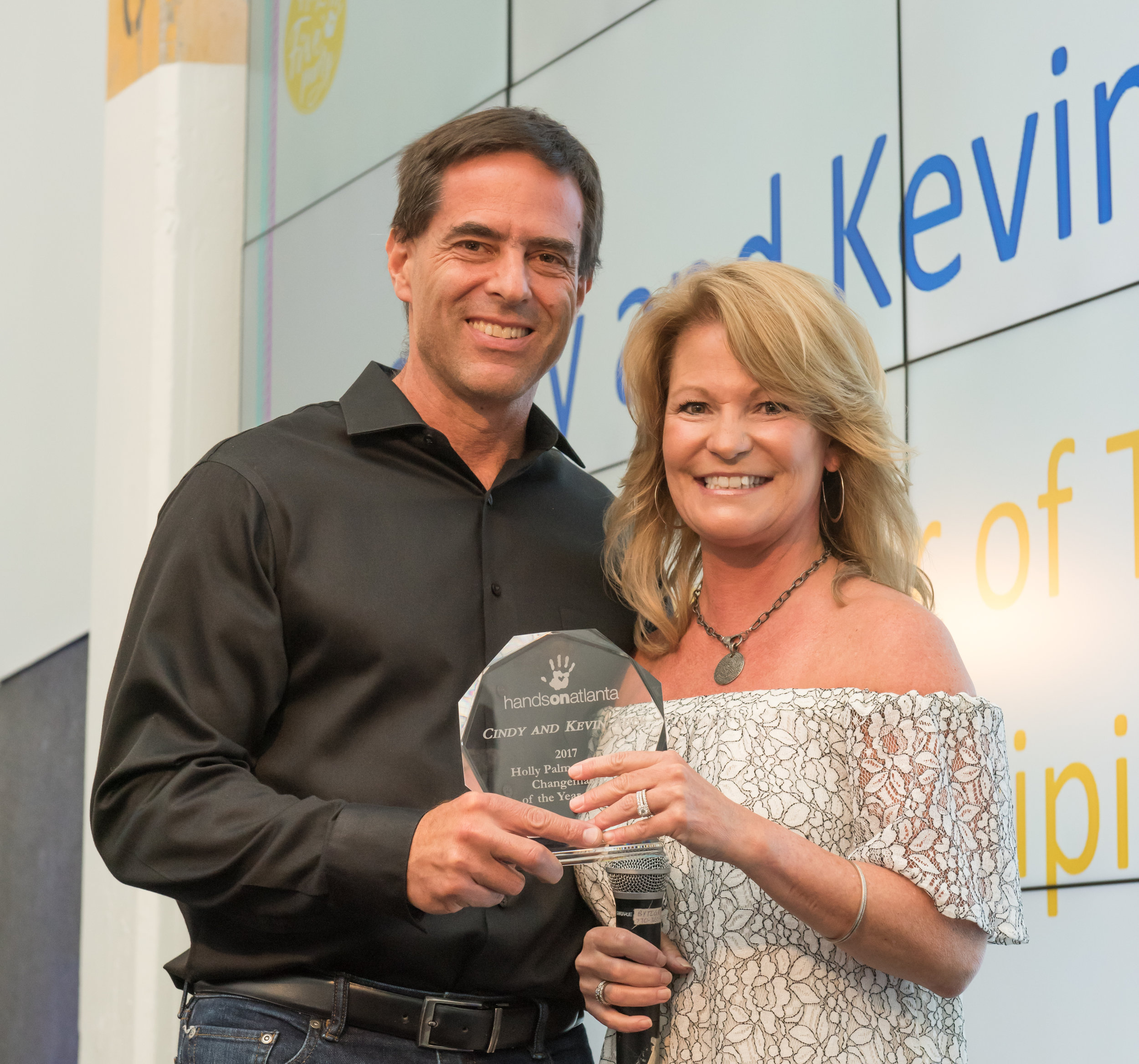
Keeping Their Hands On Atlanta, Meet Cindy and Kevin Abel
Cindy and Kevin both started their careers at Anderson Consulting before founding their own technology consulting company, Abel Solutions Inc. Cindy and Kevin Abel, long time Atlanta residents, have supported Hands On Atlanta since its founding days. In fact they attended the second volunteer orientation of the organization at the Days Inn on Buford Highway, a standing room only, packed affair that put Hands On Atlanta on the map.
Cindy and Kevin’s company, Abel Solutions, was a generous supporter from the beginning, sponsoring Hands On Atlanta Day year after year, bringing their employees, spouses and children to painting and planting projects perennially. Cindy served on the Board of Hands On Atlanta for 6 1/2 years and was Vice Chair during the latter 2 years of her term. Cindy continued as member of the Advisory Board.
Last year (2015-2016) Cindy agreed to serve as interim CEO of Hands On Atlanta while a search for a new CEO took place. Soon after Cindy’s tenure began, the Development Director moved to a new organization, leaving Cindy with not only her chief executive role, but also that of fundraiser in chief.
In 2011, Cindy and another partner co-founded Liv2bgirl, a positive place online where all girls feel comfortable being themselves, where they can connect with other girls that have common interests, goals, and concerns, and where they can safely share the ideas, thoughts, and images that define them.
Cindy and Kevin have three young adult children. Cindy has served as president of the high school PTO for the last three years, and is the past board chairperson of the Vibe Performance Company where one of her daughters danced throughout middle and high school. Kevin is vice chair of the board of New American Pathways, a refugee resettlement agency that helps refugees in Georgia thrive.